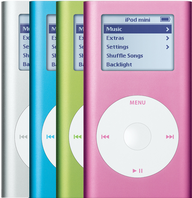
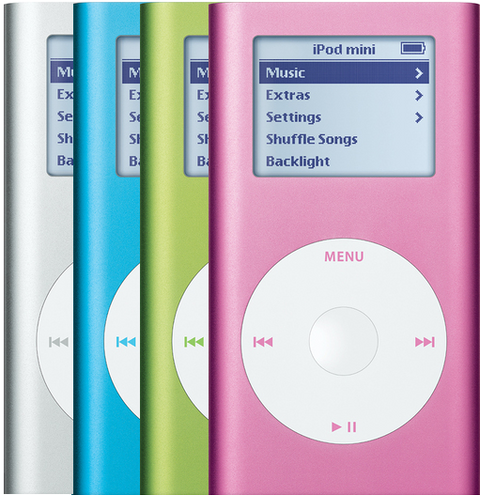
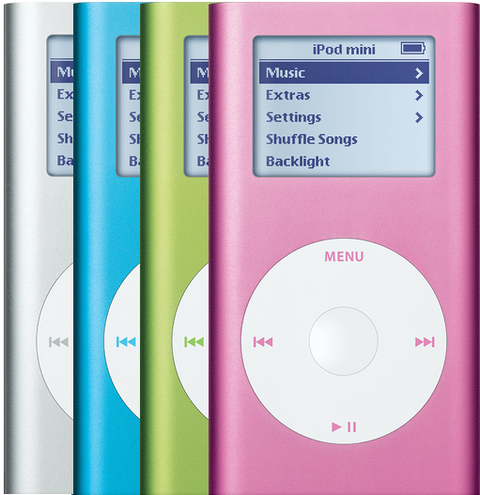
Representative photo of this model. Your unit may vary.
Refurbished iPod Mini 2nd Gen — 6GB Pink
Model A1051 · Order number M9805LL/A
$168.95
- 6GB hard drive
- New battery
- Tested by iMods
- 1-year limited warranty
Sold out
Not for sale right now
We are not selling this iPod at the moment.
- Apple original iPod, tested by iMods
- 1-year limited warranty · 30-day returns from delivery
- Built after you order: ships in 3 to 5 business days. Free US shipping on orders of $200 or more.
In the box: the iPod only, no cables.
Your iPod
This iPod
What you get with this iPod
What we did
- Tested before sale: controls, display, sync and audio
- New battery fitted
- Original 6GB hard drive, tested during restore and sync
- Original Apple case with normal signs of use
In the box
In the box: the iPod only, no cables. The 1-year limited warranty is our own cover on this iPod and runs from the date of delivery.
Versions
How to identify the iPod Mini 2nd Generation: model and order numbers
| Order number | Listing | Price |
|---|---|---|
| M9805LL/A | This listing | From $168.95 |
| M9807LL/A | Refurbished iPod Mini 2nd Gen — 6GB Green | From $168.95 |
| M9801LL/A | Refurbished iPod Mini 2nd Gen — 6GB Silver | From $168.95 |
| M9803LL/A | Refurbished iPod Mini 2nd Gen — 6GB Blue | From $168.95 |
| M9800LL/A | Refurbished iPod Mini 2nd Gen — 4GB Silver | From $155.95 |
| M9804LL/A | Refurbished iPod Mini 2nd Gen — 4GB Pink | From $155.95 |
| M9806LL/A | Refurbished iPod Mini 2nd Gen — 4GB Green | From $155.95 |
| M9802LL/A | Refurbished iPod Mini 2nd Gen — 4GB Blue | From $155.95 |
Setup and reset
How to reset, turn off and restore the iPod Mini 2nd Generation
Reset: slide Hold on and off, then hold Menu and the center button until the Apple logo appears. It keeps your music and files; some settings may reset.
Something wrong with an iPod like this? Parts and free repair quote
iPod details
About this iPod
Overview
Refurbished iPod Mini 2nd Generation — inspected, function-tested, and ready to play. Confirm the exact capacity, color, and order number on this listing before you buy.
Model snapshot
Product Overview
This refurbished iPod Mini 2nd Generation 6GB Pink is a complete working iPod listing for buyers comparing model, capacity, and condition.
Use the identification table below to confirm the exact configuration and order-number record.
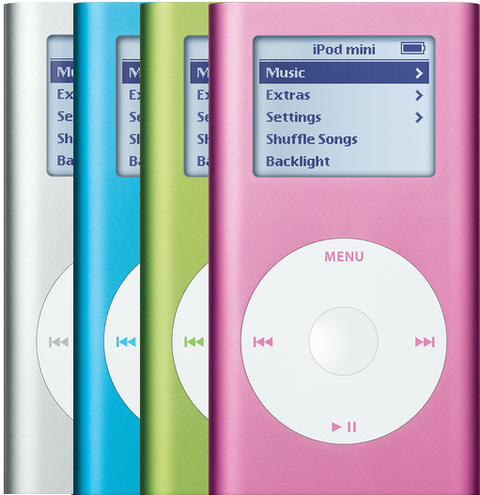
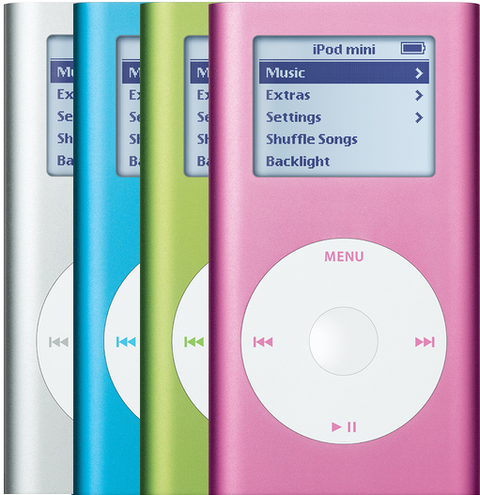
The Mini 2nd Generation was sold in four colors and two capacities. Within a capacity the color is the only difference; between the two capacities only the drive size differs. This listing is the 6GB Pink, order number M9805LL/A.
Choose Your Option
This refurbished iPod comes in multiple configurations. Confirm capacity, color, order number before choosing.
Refurbished iPod Mini 2nd Generation 6GB Pink M9805LL/A. iPod Mini logic platform processor, Wolfson WM8731 audio codec, 18-hour battery life.
You're viewing this optionAbout This iPod
Apple removed gold from the color palette, kept silver, and made blue, pink, and green more saturated. The Click Wheel symbols changed to match the body color — a quick way to distinguish a 2nd gen from a 1st gen. To hit $199, Apple removed the FireWire cable and AC adapter from the box.
Today the Mini 2nd Generation is beloved for its 18-hour battery, iconic aluminum design, and status as one of the easiest iPods to flash-mod (native CompactFlash Type II slot). Its 'killed at the peak' story, combined with the distinctive colors and easy modding, drives a strong following among collectors, modders, and daily users.
About This Variant
What this listing is. A refurbished iPod Mini 2nd Generation, 6GB in Pink, order number M9805LL/A. Apple gave both mini generations the same model number, A1051, so A1051 on its own does not tell you which mini you are looking at: the order number does, and so does the size engraved on the back panel — this generation engraves it, the first generation engraves nothing there.
What is inside. The 6GB original Microdrive on the mini's CompactFlash Type II interface, holding about 1,500 songs at Apple's 128-Kbps AAC estimate; the 1.67" grayscale display; the Click Wheel, with its text color-matched to the case as this generation always was; and a replacement battery installed unless this listing states otherwise. The capacity lives on the drive, not on the board, so a 6GB and a 4GB mini are the same iPod with a different drive in them.
How it differs from the other seven. Within 6GB the color is the only difference: the 6GB Silver, 6GB Blue and 6GB Green pages are this same iPod in a different anodised finish — same board, same display, same drive size, same battery, same box. The one difference that changes what you get is capacity — 4GB holds about 1,000 songs and 6GB about 1,500 on Apple's own estimate — and the 4GB unit in this color is the 4GB Pink. Nothing else differs between a 4GB and a 6GB mini: board, display, Click Wheel, battery, drive cable and software are the same.
| Detail | Value |
|---|---|
| Released | February 23, 2005 |
| Discontinued | September 7, 2005 |
| Original Price | US$249 |
| This Listing | M9805LL/A |
What Changed
- Storage: Added 6GB option ($249) alongside 4GB ($199) — first time a Mini offered a capacity choice
- Pricing: 4GB dropped from $249 to $199 — lowest-priced iPod mini to date. New 6GB took the $249 price point
- Colors: Gold dropped; remaining Blue, Pink, and Green received brighter, more saturated anodized finishes. Silver unchanged
How This Compares
Why buyers choose this generation: The Mini 2nd Generation is the 'best original Mini' for daily use: it keeps the beloved aluminum body and Click Wheel, adds the 6GB option, dramatically improves battery life, and is one of the easiest iPods to flash-mod. Its 7-month production run and 'killed at the peak' story give it genuine collector interest beyond pure nostalgia.
What Refurbished Means
A refurbished iPod is a complete used iPod that has been inspected, cleaned, tested, and prepared for resale; it is not a sealed-new Apple retail unit.
| Area | What this listing means |
|---|---|
| Inspection | Function-tested complete iPod with model, controls, display, sync, and audio checked before sale. |
| Battery | Replacement battery installed unless the listing states otherwise. |
| Battery Age | These iPods are about 21 years old. Original batteries are well beyond their design life. |
| Storage | Storage is tested during restore/sync checks; flash-modded units disclose the adapter path separately. Stock units keep the original Microdrive — a 20-year-old mechanical drive, so treat remaining lifespan as a bonus rather than a promise; flash-modded builds remove that moving part entirely. |
| Cosmetics | Cosmetic condition is listing-specific and may vary by shell, rear housing surface, screen lens, and engraving wear. |
What's Included
- Refurbished iPod
- One USB charge/sync cable
- 1-year limited warranty
Ships as the iPod plus one USB charge/sync cable. No wall charger or headphones are included.
The warranty. This refurbished iPod carries a one year limited warranty from us, running from the date of purchase. Apple's own 2005 warranty on this iPod expired long ago and does not apply. The returns window shown on that page is a separate thing from the warranty term: the warranty is one year.
Not in the box. No wall charger, no headphones, no FireWire cable, no dock and no original packaging. Apple itself dropped the FireWire cable and the AC adapter from this generation's retail box; we ship one USB charge/sync cable, and the iPod charges from a computer's high-power USB 2.0 port or from a USB charger you already own. Apple's own guide gives about four hours for a full charge.
Fitting. Nothing here needs fitting — this listing is a complete, assembled, working iPod. Where we offer fitting on a component, it is a separate choice you make when you order and is never folded into the price.
Model and specs
Exact Model Identification
| Detail | Value |
|---|---|
| Order Number | M9805LL/A |
| Apple Model Number | A1051 |
| Capacity | 6GB |
| Color | Pink |
| EMC | EMC 2044 |
A1051 is the Apple model number of both mini generations, so it identifies the family and not this iPod. The order number above does. So does the back panel: Apple documents this generation as the one where "The hard-drive size is engraved on back of the device" and where "The Click Wheel text color matches the color of the device". The first-generation mini is a separate model with its own wheel, screen and board — see its own pages.
All Available Variants
| Order Number | Capacity | Color | Released | Refurb |
|---|---|---|---|---|
| M9800LL/A | 4GB | Silver | February 2005 | View refurb |
| M9802LL/A | 4GB | Blue | February 2005 | View refurb |
| M9804LL/A | 4GB | Pink | February 2005 | View refurb |
| M9806LL/A | 4GB | Green | February 2005 | View refurb |
| M9801LL/A | 6GB | Silver | February 2005 | View refurb |
| M9803LL/A | 6GB | Blue | February 2005 | View refurb |
| M9805LL/A | 6GB | Pink | February 2005 | This page |
| M9807LL/A | 6GB | Green | February 2005 | View refurb |
Specifications
| Specification | Value |
|---|---|
| Processor | iPod Mini logic platform |
| CPU | Dual ARM7TDMI, 80 MHz |
| RAM | 32 MB |
| Storage | 6GB Microdrive — a 1-inch drive on a CompactFlash Type II interface. Stock units carry a Hitachi Microdrive 3K6 or a Seagate ST1 depending on the unit: HMS360604D5CF00 / ST640211CF at 4 GB, HMS360606D5CF00 / ST660211CF at 6 GB. |
| Display | 1.67" Grayscale 138x110 |
| Audio Codec | Wolfson WM8731 |
| Battery (Original) | Original: Li-Ion, Apple-rated 18 hours music. Refurbished: New (up to 600 mAh). Apple never published a capacity for this battery; replacement packs are labeled anywhere from 400 to 650 mAh under the EC003 / EC007 codes — treat the label as a label, and treat far higher numbers as relabels. |
| Music Playback | Up to 18 hours — Apple's original rating for a new battery, not a promise for a 21-year-old iPod |
| Connectivity | USB (Sync & Charge), FireWire (Sync & Charge) |
| Dimensions | 3.6 x 2.0 x 0.5" |
| Weight | 3.6 oz (102 g) |
| Model Number | A1051 |
| Original Price | US$249 |
Compatibility
Modern Sync Notes
- Broad compatibility: works with all popular Windows versions — Windows XP, Windows 7, Windows 8, Windows 10, and Windows 11 — as well as Macs. Apple's stated minimum for this iPod is iTunes 4.7; in practice, use a current iTunes for Windows, or the newer Apple Devices app, on the computer you intend to sync with.
- macOS: macOS Sequoia 15.4 and later can break native iPod recognition for some owners; if Finder or Apple Music does not see the iPod, use a Windows PC or an older Mac for restore and sync.
- Windows: on current Windows, restore and sync with iTunes for Windows, or the newer Apple Devices app.
- Streaming: These iPods do not provide native Spotify, Apple Music streaming, Wi-Fi, or Bluetooth.
Original System Requirements
- Minimum Mac OS: Mac OS X 10.2.8 or later
- Host Port: Built-in high-power USB 2.0 or FireWire port. Most keyboard USB ports do not provide enough power.
- Windows: Windows 2000 SP4 required; Windows XP SP2 required
Known OS Compatibility Issues
- macOS Sequoia 15.x: Legacy iPod recognition may be unreliable on newer macOS releases; 32-bit iTunes unavailable. Workaround: use iTunes for Windows, or the newer Apple Devices app, on a Windows PC, or an older Mac with a known-good iPod sync path.
Rockbox
Status: Supported
Build: IPOD_MINI2G
Stable target. Daily builds 4.0+ recommended for SD-via-CF adapters (older builds may cause poor battery life with CF adapters).
iTunes Compatibility
- Minimum: iTunes 4.7
- Recommended: a current iTunes for Windows, or the newer Apple Devices app, on the computer you intend to sync with
- Note: iTunes 12.x on Windows still supports iPod Mini sync. macOS Catalina+ replaced iTunes with Apple Music, which has limited but functional iPod support.
Flash Storage Upgrade
A stock refurbished iPod can keep its original storage style, but many buyers choose flash storage when they want a quieter, lower-power player with fewer moving parts. To order this iPod with flash storage fitted, choose a flash size under Storage; for an iPod you already own, see our flash mod service (installed by mail).
| Topic | Buyer Guidance |
|---|---|
| Why buyers upgrade | No moving parts, silent operation, lower power draw, improved battery life, and room for higher-capacity libraries. |
| Maximum confirmed capacity | Builds up to 256GB are confirmed (128GB on a plain CF card); anything larger is unproven. The confirmed 256GB build is a CF-to-SD flash adapter with a 256GB memory card. |
| Format requirement | SDXC cards (64GB+) must be pre-formatted to FAT32 before use — default exFAT not supported |
| Rockbox | Rockbox is supported (IPOD_MINI2G); Stable target. Daily builds 4.0+ recommended for SD-via-CF adapters (older builds may cause poor battery life with CF adapters). |
Other Models to Consider
Compare refurbished iPods across the other model families, or jump to flash mods for this generation:
Setup and care
Battery Safety & Shipping
How to tell a pack has swollen on this model. The pack lies behind the display, so the signs show at the front and the seams: a lifted or bowed display panel, a dark blot or pressure mark spreading across the picture, a top or bottom bezel starting to lift, or a case that no longer sits flat. Held beside a new pack, a swollen one is visibly domed. Do not press a lifted panel or a raised bezel back down. A Click Wheel that has gone stiff or unresponsive is a different fault on the mini — the pack sits behind the screen, not behind the wheel. If you see any of these signs, stop charging it and tell us; the replacement battery page carries the service path.
⚠️ Lithium-Ion / Li-Po Battery Safety. This product contains (or is) a rechargeable lithium-ion/lithium-polymer battery. Charge only with a compatible charger and unplug once fully charged. Avoid charging or storing in direct sunlight or other high-heat environments. Stop using and stop charging immediately if the battery swells, bulges, gets unusually hot, hisses, smokes, or leaks. Do not puncture, crush, bend, short-circuit, or try to "deflate" a swollen cell, and never press a lifted screen or case back down — it can rupture the cell. If electrolyte contacts your eyes, flush with clean water for 15 minutes without rubbing and seek medical care; on skin, wash with water and soap. Battery service should be done by a trained technician. Recycle through an electronics or universal-waste recycler, not household trash.
Shipping. A refurbished iPod shipped with its battery installed is handled as lithium-ion batteries contained in equipment (UN3481); a loose replacement cell is handled as a lithium-ion battery (UN3480). Carrier, packaging, and destination restrictions can vary, so follow the current checkout and shipping instructions for the offered route.
Questions
Buyer FAQ
Should I buy 4GB or 6GB?
4GB holds about 1,000 songs; 6GB holds about 1,500 (Apple's 128-Kbps AAC estimate). If you plan to flash-mod to a larger SD card, stock capacity matters less — buy on color and condition. If you want the original experience, 6GB gives 50% more room for $50 more at original retail, and 6GB units are slightly scarcer. This listing is the 6GB (M9805LL/A); the same color in 4GB is the 4GB Pink. To read a mini you already own: this generation has its capacity engraved on the back, and the order number settles it too — M9800LL/A, M9802LL/A, M9804LL/A and M9806LL/A are the 4GB units, M9801LL/A, M9803LL/A, M9805LL/A and M9807LL/A the 6GB ones, so an even final digit means 4GB and an odd one means 6GB.
What's the difference between the 1st and 2nd gen Mini?
The 2nd gen more than doubled rated battery life (8 to 18 hours), added a 6GB option, dropped gold, used more saturated colors, and color-matched the Click Wheel text to the body. It also dropped the price to $199. The 1st gen's edges are the exclusive gold color and the in-box FireWire cable and AC adapter.
How do I tell if my Mini is 1st or 2nd gen?
Both are model A1051. Quick tells: the 2nd gen has capacity engraved on the back and Click Wheel text matching the body color. The first-generation mini has no capacity engraving, and it has gray inset wheel text on every color; on this generation the wheel text matches the case color. If it says 6GB, it's definitely a 2nd gen.
Does this work with my Mac or PC?
On Windows, use iTunes for Windows, or the newer Apple Devices app — Apple's stated minimum for this iPod is iTunes 4.7. On older Macs, iTunes or Finder works. macOS Sequoia 15.4+ has unreliable iPod recognition — use a Windows PC or an older Mac for reliable syncing. The Mini charges and syncs over both USB 2.0 and FireWire 400.
How long does the battery last?
Apple rated the 2nd gen at up to 18 hours when new. These are 20+ year old devices — original batteries are well past useful life. Refurbished units ship with a new replacement battery unless this listing says otherwise. Apple's own guide gives about four hours for a full charge. Owners who pair a fresh pack with a flash card report runtimes beyond the original 18-hour rating — that is an owner report, not a promise.
Can I flash mod a Mini 2nd Generation?
Yes — the Mini is one of the easiest iPods to flash mod. The stock Microdrive uses a native CompactFlash Type II connector, so a CF card or CF-to-SD adapter drops in directly. Users have confirmed up to 256GB working. Format cards 64GB+ as FAT32. One hard-drive cable serves both mini generations, so the ribbon is the one storage part you do not have to match by generation, and it is a separate part from the drive.
Can I use Spotify or Apple Music on it?
No streaming apps run on the iPod mini. It plays only local files synced from a computer. Apple Music subscription tracks cannot be synced. For additional format support (FLAC, Ogg), install Rockbox (IPOD_MINI2G build).
Can I use an iPod mini in my car?
Yes — three common routes: a 3.5mm aux cable from the headphone jack, a 30-pin adapter for dock-connector car kits, or an FM transmitter where there is no aux input. The Mini has no built-in Bluetooth, but a small Bluetooth transmitter in the headphone jack adds wireless audio to modern cars.
It has arrived — what should I check first?
Charge it first: connect it to a computer's high-power USB 2.0 port or to a USB charger and look for the lightning bolt in the battery icon — Apple's guide gives about four hours for a full charge, and most keyboard and hub ports do not supply enough power. Then check that the Hold switch is off, scroll and click the wheel, listen to both headphone channels, look at the display against a plain white screen, confirm the back says 6GB, and connect it and let a sync finish. If it will not respond, reset it: toggle the Hold switch on and off, then press and hold Menu + Select for at least 6 seconds until the Apple logo appears — that is Apple's own sequence for this iPod. Guides that say Menu + Play describe the older, pre-click-wheel iPods. Finally, look for the swollen-battery signs described under Battery Safety above — a lifted or bowed display panel, a dark blot spreading across the picture, a case that will not sit flat — and tell us rather than pressing anything back down.
Restore & sync
My mini stops at the Apple logo and then shows a folder with an exclamation mark. Is that the battery?
No — that pair of icons is the software-fault class, and the giveaway is that the behavior is identical before and after a new, charged pack goes in.
Reset first: hold Menu + Select until the unit restarts. Guides that say Menu + Play describe the older, pre-click-wheel iPods.
If it still stops there, restore it — on Windows that is iTunes for Windows, or the newer Apple Devices app; the final software issued for this model is 1.4.1. A restore erases the iPod, so copy anything that exists only on it first. Apple still hosts the January 2006 iPod Updater, but it only runs on Windows XP-era or Mac OS X 10.3.9-era computers.
If the restore will not complete and the folder icon comes back, the fault class moves to the storage — the sad-face and storage entries on the microdrive pages carry that path. Reported by 1 owner.
What those screens mean. A folder with an exclamation mark means the iPod cannot find its storage — the drive, its ribbon cable, or the software on it. A sad-face iPod icon is the same message in the older style: it cannot use its hard drive. A screen pointing at Apple's iPod support page is a storage error, not a message from us. None of the three is a verdict on which part has failed; they say the iPod could not start from its own storage, and the answers here are the order to work in.
iTunes and the file manager freeze whenever the iPod is plugged in. What now?
The unit can look completely normal on its own screen, and then the moment it is plugged in iTunes takes many minutes to open and stops responding, with the file manager hanging alongside it.
On this generation the reading that fits is corrupted storage: the computer hangs while it tries to mount the iPod's disk and read it. Nothing is proven until a restore is tried, so work in that order.
Put the unit into Disk Mode first, which shows the drive to the computer without booting the iPod's own software: reset by holding Menu + Select, then the instant the unit restarts hold Select + Play until the Disk Mode screen comes up.
Then restore it, naming the software file yourself rather than letting a hanging session choose: hold Shift (Windows) or Option (Mac) while clicking Restore and point it at Apple's 1.4.1 file, the final software issued for this model. On Windows use iTunes for Windows, or the newer Apple Devices app. A restore erases the iPod, so copy anything that exists only on it first, and a restore run from a PC lays down the Windows (FAT32) format.
If the hang outlives a clean restore, the storage itself is the suspect — the sad-face and storage entries on the microdrive pages carry that path. Reported by 1 owner.
My Windows PC does not see the iPod. What do I check?
One owner reports the iPod invisible to Windows: nothing appears in iTunes and nothing shows in the file manager when the cable goes in. Nearly all of the checks are free.
Strip the USB bus back to basics: disconnect other USB devices (printers, cameras, flash drives) and try the iPod on each port in turn — a single dead port is common on older machines. Swap in a second known-good cable if you have one, and make sure it seats firmly at both ends. Look at the dock connector itself: dust, lint or corrosion across the pins breaks the data path before software gets a say.
Then the computer side: restart it, bring Windows and the sync software up to date — on Windows that is iTunes for Windows, or the newer Apple Devices app — and in Device Manager, under Universal Serial Bus controllers, enable a device entry that shows a disabled marker, or uninstall and reinstall the entry to force Windows to re-detect the hardware. Recognition on the newest macOS is reported unreliable for this era of iPod, so an older Mac or a Windows machine is the more predictable sync host.
Test the iPod's own side with Disk Mode: reset by holding Menu + Select, then the moment the unit restarts hold Select + Play until the Disk Mode screen shows. A unit that mounts in Disk Mode but not in a normal boot moves the suspicion from the cable toward software or the drive. This generation syncs and charges over USB 2.0, with FireWire 400 as the second supported interface, so if the same iPod and cable work on another computer the iPod side is proven.
Bent or corroded pins are on the 30-pin port itself, which is part of the logic board on this model — the metal bracket only locates it; a damaged port is a logic-board or mail-in repair. Reported by 1 owner.
You May Also Want
Replacement batteries available if the included battery needs future service.
Related: Flash Mod Service (installed by iMods)Upgrade the original microdrive to flash storage for improved durability.
Related: Replacement Microdrive (6GB)The capacity this listing ships with. Use a hard drive only when restoring original-style storage; use the model's flash-storage path when a compatible adapter path is available.
Related: Replacement Microdrive (4GB)The other factory capacity. Use a hard drive only when restoring original-style storage; use the model's flash-storage path when a compatible adapter path is available.
Search terms
Why people land on this part
Common Names & Search Terms
Buyers find this iPod using these names and phrases:
Product Names
ipod mini 2nd generation refurbished, ipod mini 2g refurbished, ipod mini 4gb blue, ipod mini 6gb pink, ipod mini A1051 refurbished, M9800LL/A, M9801LL/A, M9803LL/A, M9805LL/A, ipod mini 2nd gen new battery, iPod mini 2nd generation 6GB pink refurbished
What Buyers Are Looking For
best small ipod for running, ipod for car aux, offline music player, ipod mini daily driver, ipod mini for gym
Collector & Enthusiast Terms
ipod mini sealed in box, rarest ipod mini color, ipod mini 6gb rare, ipod mini pink 6gb
Compatibility Questions
ipod mini sync with mac, ipod mini macos sequoia, rockbox ipod mini 2g, ipod mini flash adapter, ipod mini sd card upgrade
Refurbished and custom
Your music. Your kind of iPod.
Pick your iPod, then its color, storage and battery. On the iPod Video 5th Gen and the iPod Classic 6th and 7th Gen you can also choose a new case in your colors and, with flash storage, the 2000mAh extended-life battery. Every iPod we sell is cleaned, tested, fitted with a new battery and covered by a 1-year limited warranty.
Want a silent iPod? Choose flash storage: it has no moving parts to wear out, and it goes up to 1TB on the 60GB and 80GB iPod Video 5th Gen and the iPod Classic 7th Gen.